Why Europe’s AI Future Doesn’t Look Like Silicon Valley’s
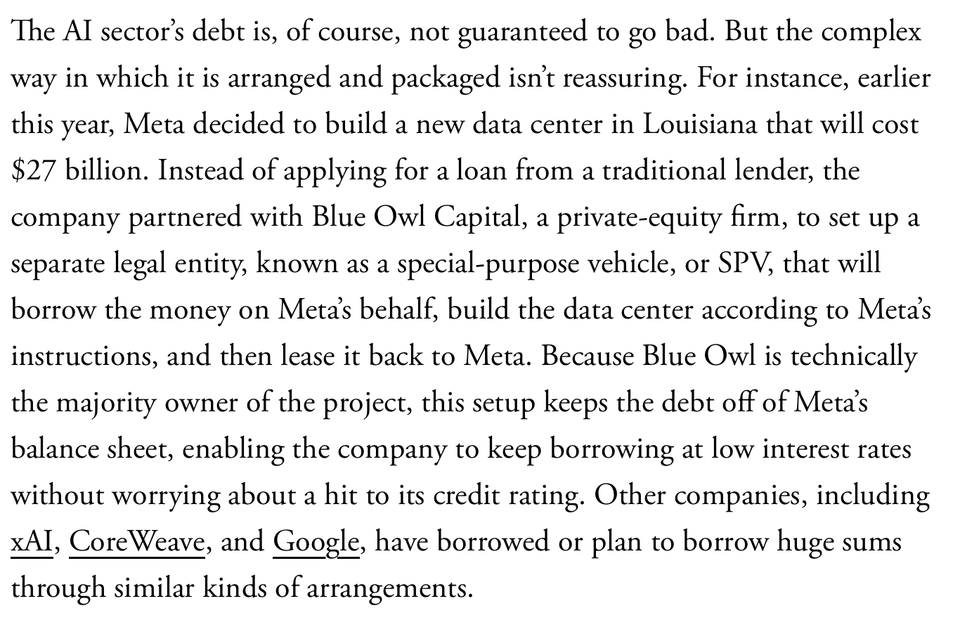
Over the past year, a growing number of analysts have started to ask an uncomfortable question: what happens if the AI boom turns out to be a bubble? Not just a slowdown, but a real unwinding of debt, overcapacity, and inflated expectations. Recent reporting on how large AI data centers are being financed in the United States only adds fuel to that concern. Massive projects are being built using complex financial structures that keep debt off company balance sheets, relying on private equity, special-purpose vehicles, and optimistic assumptions about future demand for compute.
The financial engine behind the AI boom
If such a bubble were to burst, Europe would certainly feel the impact. But it would not be hit in the same way as the United States, and that difference matters. In fact, it may even give Europe an opening to build something more durable.
The epicenter of the current AI boom is unmistakably American. The largest investments are happening around hyperscale data centers, enormous GPU clusters, and consumer-facing AI platforms that require staggering amounts of capital upfront. These projects are often financed with cheap debt and structured in ways that allow companies to keep borrowing without damaging their credit ratings. The risk here is not just technological, but financial. If AI demand grows more slowly than expected, or if prices for AI services fall faster than anticipated, those financial structures could start to crack.
Why Europe is less exposed
Europe, by contrast, has far less direct exposure to this kind of risk. There are fewer hyperscale bets, less private credit flowing into AI infrastructure, and generally more conservative financing across the board. That does not mean Europe would be immune to a downturn. Venture capital would tighten, valuations would come down, and some AI startups would struggle or fail. But the likelihood of a systemic shock comparable to past financial crises is much lower.
Part of the reason lies in structural differences. Europe never fully embraced the “build first, monetize later” logic that dominates Silicon Valley. Higher energy costs, stricter regulation, and fragmented markets make it much harder to justify enormous speculative investments. While this has often been framed as a weakness, it also acts as a brake on excess. Hype cycles move more slowly, and business cases are expected to make sense earlier.
Enterprise AI versus consumer AI
Another key difference is how AI is being used. In the United States, much of the current excitement is driven by consumer-facing tools, advertising models, and the promise of general-purpose AI systems that can do everything for everyone. These models depend on scale above all else. In Europe, AI adoption is far more concentrated in enterprise and industrial contexts. Companies are using AI to optimize energy usage, manage logistics, improve manufacturing processes, handle compliance, and support sustainability reporting. These are not speculative use cases. They are tied to operational budgets and measurable returns.
Regulation as a hidden stabilizer
Regulation also plays an unexpected role here. Frameworks like GDPR, the AI Act, and upcoming sustainability reporting requirements slow things down, but they also filter out the most fragile business models. When companies are forced to think about data governance, accountability, and long-term risk, they are less likely to chase growth at any cost. In a downturn, that caution becomes an asset.
A different path forward for European AI
This sets the stage for a different kind of opportunity. If the American hyperscale model starts to wobble, Europe does not need to replace it with a smaller version of the same thing. Trying to compete head-on with trillion-dollar infrastructure plays would be a mistake. Europe’s advantage lies elsewhere.
One promising direction is domain-specific AI. Instead of massive, general-purpose models, Europe is well positioned to build smaller systems trained on high-quality, regulated data for specific industries. Energy systems, climate modeling, supply chains, healthcare administration, and industrial automation all benefit more from precision and reliability than from raw scale. These systems require far less compute and far less capital, but they can deliver very real value.
From more compute to more efficiency
Another opportunity lies in using AI to reduce consumption rather than increase it. The dominant AI narrative today assumes more compute, more energy, and more data centers. A European alternative focuses on efficiency: less waste, fewer emissions, lower operational costs. AI used to optimize processes, eliminate unnecessary work, and support better decision-making aligns naturally with Europe’s economic and environmental realities.
Automation and AI agents over hyperscale models
There is also a strong case for focusing on AI agents and automation rather than ever-larger models. Much of the productivity gain from AI comes not from intelligence in isolation, but from orchestration. Systems that connect tools, trigger actions, and support human decision-making can transform organizations without requiring massive infrastructure. This approach fits well with Europe’s large base of small and medium-sized enterprises, as well as the public sector.
What happens after the hype fades
If an AI bubble does burst in the United States, it may even accelerate these trends. Hardware prices would likely fall, scarce talent would become available, and the hype-driven business models would be cleared out. That kind of reset often creates space for more sustainable approaches to emerge.
Historically, Europe has rarely won by moving fastest during periods of technological euphoria. It tends to do better after the dust settles, when long-term value matters more than growth narratives. If AI is entering that kind of phase, Europe’s slower, more constrained path may turn out to be an advantage rather than a liability.
The real risk for Europe
The real risk for Europe is not being hurt by an AI bubble elsewhere. The real risk would be trying to copy a model that was never designed for its economic, regulatory, and social context. The opportunity is to build AI that saves energy instead of consuming it, supports real industries instead of speculative ones, and delivers steady value instead of chasing exponential promises. In a world coming down from hype, that may be exactly what the market needs.