The Wennink Report: A Necessary Wake-Up Call, but Not Yet a Public Value Strategy.
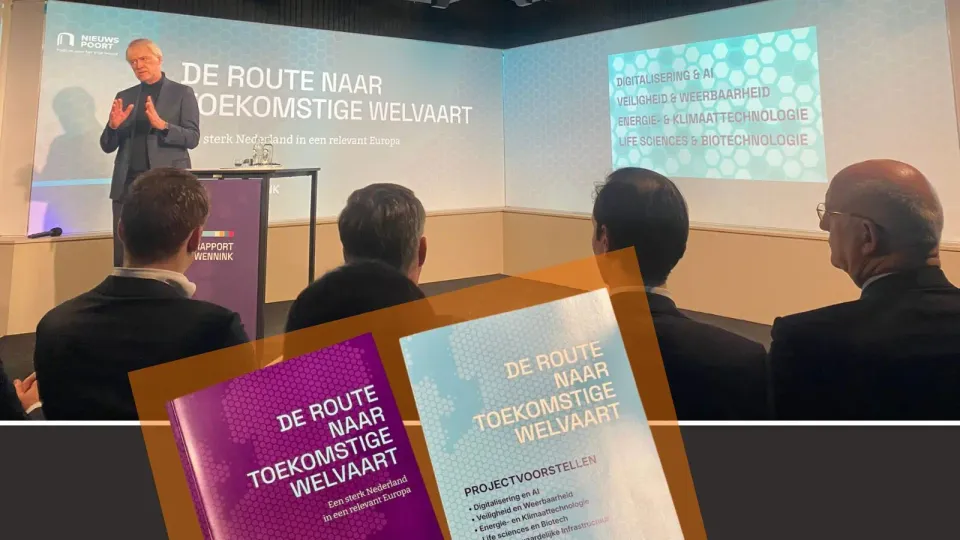
The publication of the Wennink Report is an important moment in the Dutch economic debate. It breaks with years of underinvestment rhetoric and clearly states that the Netherlands must invest at scale to secure future prosperity. In that sense, the report is both timely and necessary.
Yet while the diagnosis is strong, the underlying policy logic remains constrained by a familiar framework. The report stays firmly within the traditional Dutch public-private partnership (PPP) model — a model that leading economists, innovation scholars, and European policymakers increasingly consider insufficient for the strategic technologies of the 21st century.
A Strong Diagnosis, a Conservative Policy Logic
The Wennink Report rightly emphasizes:
- the urgency of long-term investment,
- the strategic importance of technology, digital infrastructure and innovation,
- the need for institutional coordination and patient capital.
However, its proposed solution largely follows a familiar pattern: the state improves conditions, reduces risk, and mobilizes private investment. Growth and societal benefit are expected to emerge indirectly. This assumption is precisely where the debate has shifted internationally.
Socialized Risk, Privatized Reward.
A growing body of research shows that modern innovation systems are not driven by private entrepreneurship alone, but by deep, early-stage public investment, often without proportional public return. Mariana Mazzucato’s work, including The Entrepreneurial State (2013) and later OECD-commissioned research, documents how public institutions:
- funded the foundational technologies behind the internet, GPS, semiconductors and AI,
- absorbed the highest levels of uncertainty,
- but largely failed to retain ownership, equity or revenue rights.
OECD reports on innovation-led growth (notably Mission-Oriented Innovation Policies, 2018) confirm this pattern:
when public investment lacks explicit return mechanisms, value capture systematically shifts to private actors.
The Wennink Report does not meaningfully challenge this structural imbalance.
Why This Matters Especially for AI, Cloud and Digital Infrastructure
The limitations of the PPP model become most problematic in sectors such as:
- artificial intelligence,
- cloud computing and data centers,
- cybersecurity,
- digital public infrastructure.
According to the European Commission’s Digital Decade and multiple studies by Bruegel and the European Council on Foreign Relations, these sectors are characterized by:
- extreme economies of scale,
- strong network effects,
- high switching costs,
- and strategic geopolitical relevance.
In such environments, market concentration is not a failure , it is the default outcome. Without public ownership or governance at the foundational layer, states risk long-term dependency on a small number of dominant platforms.
What Is Missing is Public Value as a Design Principle
Despite its focus on strategic technologies, the Wennink Report does not articulate a framework for public value creation in the digital economy. Notably absent are:
- a definition of public return beyond indirect spillovers,
- a role for open-source as strategic infrastructure,
- public intellectual property strategies,
- or governance models for shared digital assets.
This stands in contrast to evolving European practice. Across Europe, several countries and institutions are already experimenting with more explicit public value models:
France: Public Stakes in Strategic Tech
France has long used Bpifrance not only as a lender, but as an equity investor in strategic sectors, including AI and deep tech. The French state explicitly treats equity participation as a tool for aligning innovation with long-term national interests.
Germany: Sovereign Digital Infrastructure
Germany’s federal government has invested in sovereign cloud and open digital infrastructure, including public-sector-backed cloud initiatives and open standards for public administration. These are treated as strategic assets, not just market opportunities.
European Union: Open Source as Policy
The European Commission’s Open Source Software Strategy (2020–2023, renewed for 2024+) explicitly frames open source as:
- a driver of digital sovereignty,
- a tool for reducing vendor lock-in,
- and a way to ensure long-term public value from public spending.
Large EU-funded projects increasingly mandate open standards or open-source components, a logic absent from the Wennink framework.
Public Risk Should Mean Public Return
A growing consensus among innovation economists and European policy institutions is that public risk requires public return — not as ideology, but as system design. This does not mean the state should “run everything.” It means that for strategic, foundational technologies, governments should selectively use:
- equity stakes or golden shares,
- public ownership of core IP or foundational models,
- revenue-sharing or royalty mechanisms,
- and direct investment in open-source digital commons.
Such mechanisms are widely recognized, including by the OECD and the European Investment Bank as compatible with competitive markets, while ensuring societal returns.
From Investment Volume to Investment Purpose
The Wennink Report focuses primarily on how much needs to be invested and how fast. What it does not sufficiently address is how value is governed, captured and redistributed. In an economy increasingly shaped by AI, data and digital infrastructure, neutrality is an illusion. Choosing not to define ownership, governance and public value is itself a political and economic choice, one that risks repeating past dependencies.
A First Step, Not a Strategy
The Wennink Report is an important starting point. It reopens the investment debate and acknowledges the scale of the challenge. But it does not yet offer a public value strategy for the digital age.
Without explicit mechanisms for public return, a strategic role for open-source and shared digital infrastructure, and a rethinking of ownership in foundational technologies, the Netherlands risks investing heavily while remaining structurally dependent. The next step is not only to invest more — but to invest with public value by design.